We Do Books™ Blog
The information provided on this site is for general informational purposes only and should not be construed as professional financial, tax, or legal advice. For advice tailored to your specific situation, we recommend consulting with a qualified professional. We Do Books is here to assist by calling 855-922-WeDo (9336)
No Tax on Overtime? What the New 2025 Overtime Deduction Really Means
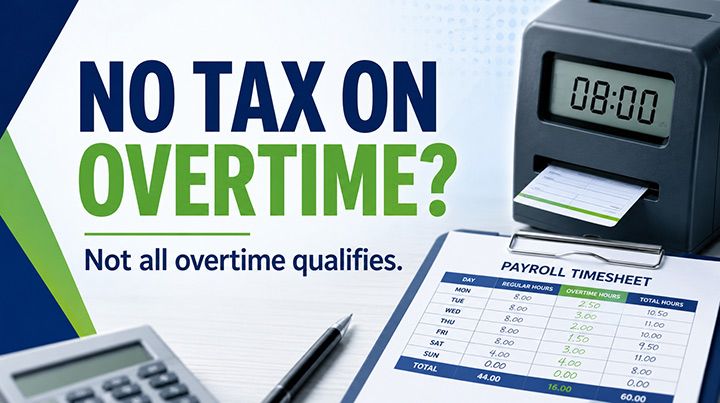
No Tax on Overtime? What the New 2025 Overtime Deduction Really Means
Beginning with the 2025 tax year, a new federal deduction may allow certain workers to reduce their federal taxable income for some overtime pay.
This new rule is commonly being called No Tax on Overtime. That sounds wonderful. It also sounds much simpler than it really is, which is usually where the tax code walks in wearing muddy boots.
The rule does not mean that all overtime wages are tax-free. It does not mean payroll stops withholding taxes on overtime. It does not mean the full time-and-a-half paycheck disappears from taxable income.
What it means: Eligible taxpayers may be able to deduct the qualified overtime premium portion of their overtime pay on their federal income tax return.
For tax years 2025 through 2028, the deduction generally applies to the portion of qualified overtime compensation that exceeds the worker's regular rate of pay, such as the half portion of time-and-a-half compensation required under the Fair Labor Standards Act, commonly called the FLSA.
What Is Qualified Overtime?
Qualified overtime compensation generally means overtime pay required under Section 7 of the FLSA. Under the FLSA, covered nonexempt employees generally must receive overtime pay when they work more than 40 hours in a workweek, at a rate of at least one and one-half times their regular rate of pay.
For tax purposes, the important part is this: the deduction generally applies only to the overtime pay above the employee's regular rate of pay.
In plain English, for normal time-and-a-half overtime, only the extra half-time premium may qualify.
Simple Example: Time-and-a-Half Overtime
Assume an employee earns $20 per hour. When that employee works qualified overtime, they are paid time-and-a-half, or $30 per hour.
| Item | Amount |
|---|---|
| Regular hourly rate | $20 |
| Overtime rate | $30 |
| Qualified overtime portion | $10 |
The employee received $30 for the overtime hour, but only $10 is the qualified overtime portion for this deduction. The regular $20 portion is still regular wage income.
That is the part many taxpayers may miss. The full overtime paycheck is not necessarily deductible. The deduction is generally limited to the overtime premium required under the FLSA.
What Does Not Automatically Qualify?
Not every type of extra pay qualifies. This deduction is tied to overtime required under the FLSA. That means some premium pay may not qualify, even if employees casually call it overtime.
| Type of Pay | Does It Automatically Qualify? | Why |
|---|---|---|
| FLSA overtime over 40 hours in a workweek | Yes, generally the premium portion | This is the core rule |
| Regular wages paid during overtime hours | No | Only the premium portion may qualify |
| Holiday premium pay | Usually no | FLSA does not automatically require extra pay for holidays |
| Weekend premium pay | Usually no | FLSA does not automatically require extra pay for weekend work |
| State-only overtime | Not automatically | The federal deduction is tied to FLSA overtime |
| Union or contract overtime | Not automatically | It must also meet the FLSA overtime requirement |
| Double-time pay | Only part may qualify | Usually limited to the FLSA-required premium amount |
The Department of Labor notes that the FLSA does not require overtime merely because work is performed on Saturdays, Sundays, holidays, or regular days of rest, unless overtime is otherwise worked under the FLSA rules.
That matters because a payroll system may label something OT, but the federal tax deduction may treat only part of it as qualified overtime.
Double-Time Example
Assume an employee's regular hourly rate is $20. The employer pays double time, or $40 per hour, for certain hours. That does not mean the full extra $20 qualifies for the deduction.
| Item | Amount |
|---|---|
| Regular hourly rate | $20 |
| Double-time rate | $40 |
| FLSA time-and-a-half rate | $30 |
| Qualified overtime portion | $10 |
In this example, the qualified overtime portion may be only $10 per hour, because that is the half-time premium required under the FLSA. The remaining extra amount may be additional employer-paid premium compensation, but not necessarily qualified overtime for this deduction.
For 2025, IRS examples explain that when total time-and-a-half overtime is reported as one combined amount, the qualified overtime premium may be calculated as one-third of the total overtime amount. If double-time overtime is reported as one combined total, the qualifying FLSA premium may be calculated as one-fourth of that total amount.
How Much Can Be Deducted?
| Filing Status | Maximum Deduction |
|---|---|
| Single, Head of Household, or most taxpayers | $12,500 |
| Married Filing Jointly | $25,000 |
The deduction begins to phase out when modified adjusted gross income exceeds $150,000, or $300,000 for married taxpayers filing jointly.
| Filing Status | Phaseout Begins Above |
|---|---|
| Most taxpayers | $150,000 |
| Married Filing Jointly | $300,000 |
Married taxpayers generally must file jointly to claim the deduction, and the taxpayer receiving the qualified overtime compensation must have a Social Security number valid for employment.
Do You Have to Itemize to Claim It?
No. The overtime deduction may be claimed whether the taxpayer itemizes deductions or uses the standard deduction.
That is an important point because most taxpayers use the standard deduction. If this deduction required itemizing, it would be about as useful to many workers as a parachute packed by Congress.
How Will This Be Handled for 2025?
For 2025, this deduction may be messier than taxpayers expect.
Employers and other payers are not required to separately report qualified overtime compensation on 2025 Forms W-2, 1099-NEC, or 1099-MISC. Some employers may voluntarily provide the amount in Form W-2, Box 14, through a payroll portal, or on a separate year-end statement.
If the employer does not separately report the qualified overtime amount, taxpayers may need to calculate it using available payroll records and reasonable IRS-approved methods for 2025.
What Employees Should Save for 2025
- Form W-2
- Final 2025 pay stub
- Year-end payroll summary
- Any employer statement showing overtime premium
- Payroll portal reports
- Any detail showing regular hours, overtime hours, regular rate, and overtime rate
For many employees, the final pay stub may be the most important document. It may show overtime detail that does not appear clearly on the W-2.
In other words, do not throw away the pay stub. The IRS may not accept I swear it was a lot of overtime as a calculation method. They are funny that way, but not actually funny.
How Will This Be Handled in 2026?
Beginning with 2026, reporting becomes more formal. Qualified overtime compensation should be separately reported as follows:
| Form | Where Qualified Overtime Should Be Reported |
|---|---|
| Form W-2 | Box 12, Code TT |
| Form 1099-MISC | Box 14 |
| Form 1099-NEC | Box 1d |
IRS guidance says taxpayers can use this information when figuring the qualified overtime deduction on Schedule 1-A. The 2026 Form W-2 instructions state that Box 12, Code TT is used to report the total amount of qualified overtime compensation. The instructions also note that only the half portion of time-and-a-half compensation would be reported using Code TT.
This should make 2026 cleaner than 2025. Of course, cleaner in payroll tax means we may only need one pot of coffee instead of three.
Will Payroll Stop Withholding Tax on Overtime?
Not necessarily. Overtime pay is still generally wages. The new rule creates a deduction on the income tax return. It does not automatically remove overtime from payroll withholding, and it does not generally eliminate Social Security or Medicare taxes.
IRS withholding guidance states that qualified overtime compensation is still generally subject to both the employer and employee shares of Social Security and Medicare tax. Employees may be able to adjust Form W-4 withholding if they expect to benefit from the deduction, but that should be done carefully. Too little withholding can create a balance due at tax time.
What Employers Should Do Now
Business owners should not wait until year-end to look at this. For 2026, payroll systems should be reviewed to make sure they can separately track the correct overtime components.
- Regular wages
- FLSA overtime premium
- Total overtime wages
- Holiday premium pay
- Weekend premium pay
- Shift differentials
- Bonuses that affect the regular rate of pay
- Double-time amounts
- State-only overtime
- Contractual or union overtime
This matters because payroll labels alone may not be enough. A payroll code called OT does not automatically prove the amount qualifies for the federal overtime deduction.
The cleanest payroll setup will separately identify the qualified overtime premium portion, not merely the total overtime paid.
Practical Employer Example
Assume an employee earns $20 per hour and receives time-and-a-half overtime at $30 per hour. A useful payroll breakdown would show:
| Payroll Component | Amount |
|---|---|
| Regular wage portion | $20 |
| Overtime premium portion | $10 |
| Total overtime wage | $30 |
For the federal deduction, the key amount is generally the $10 overtime premium, not the full $30 overtime wage. That distinction is going to matter for tax reporting.
Common Mistakes to Avoid
- Assuming all overtime pay qualifies. Usually, only the FLSA-required premium portion qualifies.
- Claiming the full time-and-a-half amount. The regular rate portion is not the qualified overtime amount.
- Ignoring the income phaseout. Higher-income taxpayers may receive a reduced deduction or no deduction.
- Forgetting about payroll taxes. Social Security and Medicare taxes generally still apply.
- Failing to save payroll records for 2025. Because 2025 reporting is transitional, documentation may be critical.
- Assuming state overtime automatically qualifies. State overtime rules and federal FLSA overtime rules are not always the same.
Bottom Line
The new overtime deduction can be valuable, but it is narrower than the phrase No Tax on Overtime suggests.
For most employees, the deduction applies only to the premium portion of FLSA-required overtime. In a normal time-and-a-half situation, that generally means only the extra half-time portion qualifies.
For 2025, taxpayers should keep final pay stubs and payroll summaries because employers are not required to separately report the qualified overtime amount.
For 2026, employers should make sure payroll systems are properly tracking qualified overtime so it can be reported correctly, including on Form W-2, Box 12, Code TT.
This is one of those tax rules where a little documentation now can prevent a large headache later. And unlike many tax headaches, this one may actually come with a deduction.
Important Note
This article addresses the federal qualified overtime deduction only. State income tax treatment may differ. Eligibility depends on the taxpayer's specific facts, including FLSA status, payroll records, income level, filing status, and available documentation.
When you subscribe to the blog, we will send you an e-mail when there are new updates on the site so you wouldn't miss them.