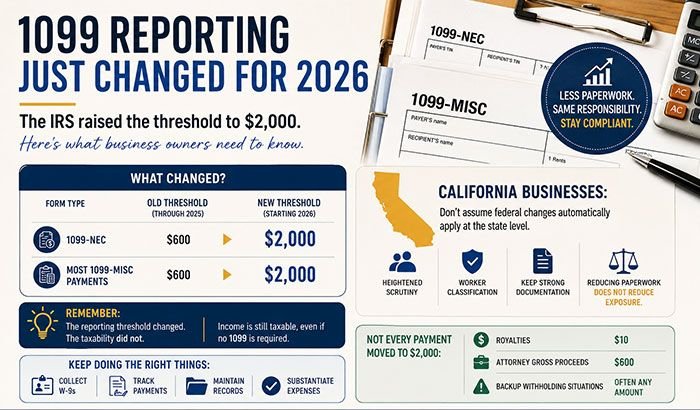
1099 Reporting Just Changed for 2026
The IRS Raised the Threshold to $2,000. Here’s What Business Owners Need to Know.
For years, business owners have been trained like Pavlov’s accountant:
“Pay someone over $600? Issue a 1099.”
That rule became so embedded into bookkeeping and tax workflows that many businesses treated it like gravity. Not necessarily because they understood it, but because fighting gravity usually ends badly.
Now, beginning with payments made in 2026, the federal reporting threshold for many Forms 1099 increases from $600 to $2,000.
At first glance, this sounds like welcome relief:
- Fewer forms
- Less administrative work
- Lower compliance burden
- Fewer January panic attacks involving missing W-9s
But as with most tax changes, the surface simplicity hides several traps underneath.
Let’s break down what changed, what did not change, and why businesses should still proceed carefully.
What Changed?
Beginning in 2026:
| Form Type | Old Threshold | New Threshold |
|---|---|---|
| 1099-NEC | $600 | $2,000 |
| Most 1099-MISC Payments | $600 | $2,000 |
This means many businesses will no longer be required to issue a 1099 to independent contractors, vendors, or service providers unless total annual payments reach $2,000.
For small businesses that issue dozens or hundreds of forms each year, this could significantly reduce paperwork.
And frankly, the IRS probably realized businesses were spending more time chasing W-9s than building their companies.
What Did NOT Change
This is the important part.
The income is STILL taxable.
A contractor who receives:
- $1,200
- $1,500
- or $1,999
still has taxable income even if no 1099 is issued.
The reporting threshold changed.
The taxability did not.
That distinction matters because many taxpayers incorrectly assume:
“No 1099 means no reporting requirement.”
The IRS disagrees with the passion of a smoke detector at 2:00 AM.
Why This Matters to Business Owners
The new threshold may reduce paperwork, but businesses should avoid becoming careless with recordkeeping.
You still need:
- Proper bookkeeping
- Vendor records
- W-9 collection procedures
- Proof of payment
- Expense substantiation
Why?
Because during an audit, the IRS examines:
- whether expenses are legitimate,
- whether workers were properly classified,
- and whether payments can be substantiated.
The absence of a required 1099 does not eliminate the need for documentation.
Example
Suppose your business hires:
- a web designer for $1,750,
- a marketing consultant for $1,400,
- and a handyman for $1,950.
Under the new rules, none may require a 1099.
But you still need:
- invoices,
- payment records,
- contracts if applicable,
- and proof the expenses were business related.
Otherwise, deductions can still be challenged.
Some Payments Still Have Lower Thresholds
Not every 1099 rule moved to $2,000.
Several categories still retain lower reporting thresholds.
Examples include:
| Payment Type | Threshold |
|---|---|
| Royalties | $10 |
| Attorney Gross Proceeds | $600 |
| Backup Withholding Situations | Often any amount |
This means businesses should not assume:
“Everything is now $2,000.”
Because the IRS enjoys exceptions the way collectors enjoy rare coins.
Should Businesses Still Collect W-9 Forms?
Yes. Absolutely.
Even if you believe a vendor may stay under $2,000, collecting a W-9 at the beginning of the relationship remains the smartest approach.
Why?
Because:
- vendors exceed expectations,
- projects expand,
- invoices accumulate,
- and December has a strange habit of showing up suddenly.
Trying to obtain a W-9 in January after someone has disappeared into the wilderness of unread emails is rarely enjoyable.
State Law Considerations
Businesses should also remember that federal 1099 thresholds do not automatically control state filing requirements.
Some states:
- may maintain separate filing rules,
- require direct state filing copies,
- or apply different compliance standards.
California Businesses Should Be Especially Careful
California historically follows many federal information reporting rules, but businesses operating in California should avoid assuming that all federal threshold changes automatically apply at the state level without verification.
Additionally, California businesses face heightened scrutiny regarding:
- worker classification,
- independent contractor status,
- payroll compliance,
- and documentation requirements.
Even if fewer federal 1099 forms are required under the new $2,000 threshold, businesses should still maintain:
- W-9 forms,
- vendor agreements,
- invoices,
- and detailed payment records.
This is especially important in California, where agencies often examine whether workers should have been treated as employees rather than independent contractors.
In other words:
Reducing paperwork does not reduce exposure.
The Administrative Impact
For many businesses, this change is actually meaningful.
Potential benefits:
- fewer forms to prepare,
- lower administrative costs,
- reduced filing fees,
- less year-end cleanup,
- fewer vendor disputes.
This especially helps:
- small businesses,
- contractors,
- startups,
- family operations,
- and businesses with many small service vendors.
The old $600 threshold had not meaningfully changed in decades despite inflation dramatically eroding its relevance.
In today’s economy, $600 barely covers:
- a minor repair,
- a website tweak,
- or three trips to Home Depot where you “only needed one thing.”
But Don’t Let Simplicity Become Sloppiness
One danger with this new threshold is psychological.
Businesses may begin treating:
- smaller vendors,
- occasional contractors,
- or undocumented payments
with less discipline simply because fewer forms are required.
That would be a mistake.
Good accounting systems do not exist merely to produce tax forms.
They exist to:
- create accurate financial reporting,
- protect deductions,
- support audits,
- and help management make intelligent decisions.
The 1099 is simply one output from a much larger financial control system.
Forward-Thinking Businesses Will Still Track Everything
The best-run businesses will likely continue:
- collecting W-9s,
- coding vendors properly,
- tracking contractor payments,
- and maintaining complete documentation.
Why?
Because organized systems scale.
Disorganized systems eventually create expensive conversations with:
- accountants,
- attorneys,
- banks,
- buyers,
- or auditors.
Usually all at once.
Final Thoughts
The new $2,000 threshold for 1099 reporting is a welcome modernization of an outdated rule.
For many businesses, it will reduce paperwork and administrative friction.
But it should not be misunderstood as:
- a relaxation of income reporting,
- weaker substantiation requirements,
- or permission to abandon documentation procedures.
The IRS may require fewer forms.
That does not mean they suddenly became casual about recordkeeping.
That would be like expecting a rattlesnake to become emotionally supportive because it upgraded its habitat.
- Need Help Building Better Financial Systems?
At Sharp CFO, we help business owners move beyond basic bookkeeping into real financial structure, operational clarity, and CFO-level decision making.
Because the goal is not simply surviving tax season.
The goal is building a business that runs clean, scales intelligently, and withstands scrutiny when it matters most.